A Screw Jack Meaning
A screw jack, also known as a jackscrew or a mechanical jack, is a mechanical device primarily used to lift heavy loads or to apply great forces. This simple yet indispensable tool is widely used in an array of industries ranging from automotive to construction, owing to its versatility and robustness. In the following sections, we will delve into the nuances of a screw jack, its working principle, applications, and the different types available in the market.
Understanding the Screw Jack
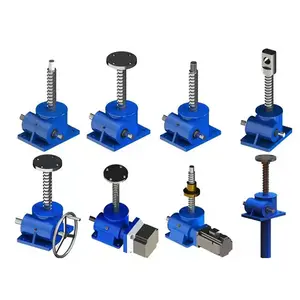
The screw jack operates on the principle of linear motion, which is a motion along a straight line, and is typically described in terms of displacement, direction, and velocity. It is a simple machine that exemplifies the concept of the mechanical advantage, where a small input force is transformed into a significantly larger output force.
The Working Principle of a Screw Jack
In essence, a screw jack converts rotational motion into linear motion. When the screw (or jack screw) is rotated, the motion is transferred to the load that needs to be lifted or moved. The screw thread acts as a continuous ramp that amplifies the force applied, allowing heavy objects to be lifted with relatively little effort.
Components of a Screw Jack
A typical screw jack consists of a few primary components. These include the screw, the nut, the handle or lever, and the housing or body. The screw is the main operational component, the nut moves along the screw when it is rotated, the handle or lever is used to apply the force required to rotate the screw, and the housing or body holds the entire assembly together and provides stability.
Types of Screw Jacks
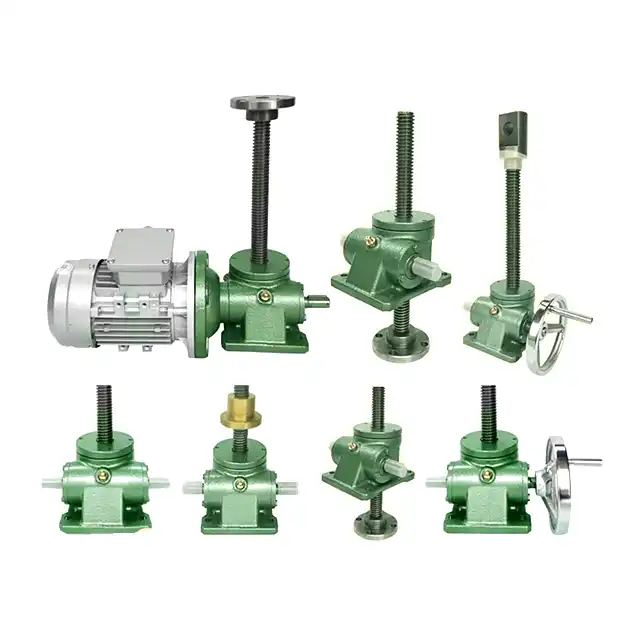
There are two main types of screw jacks – the machine screw jack and the ball screw jack. The machine screw jack is the more traditional type and is commonly used for applications that require load holding, while the ball screw jack, which incorporates rolling ball bearings, is used for applications that require efficiency and high duty cycles.
Machine Screw Jack
A machine screw jack operates on the principle of sliding friction. The load is moved or lifted by rotating the screw, which in turn moves the nut. Machine screw jacks are best suited for applications that require low speed, high precision, and can tolerate a bit of self-locking. They are widely used in a variety of industries for tasks such as lifting, lowering, pushing, pulling, and moving.
Ball Screw Jack
A ball screw jack, on the other hand, operates on the principle of rolling friction. It incorporates ball bearings that reduce friction, making it more efficient and suitable for high-speed applications. Ball screw jacks are typically used in applications that require high speed, high frequency, and high precision.
Applications of Screw Jacks
Screw jacks have a wide range of applications across various industries. In the automotive industry, they are commonly used to lift vehicles for maintenance or tire changes. In the construction industry, they are used to support heavy loads such as bridges or buildings during construction or repair. Screw jacks are also used in industrial machinery for tasks such as adjusting conveyor belt height or aligning components during assembly.
Conclusion
In conclusion, a screw jack is a simple yet powerful tool that converts rotational motion into linear motion to lift or move heavy loads. Its versatility, robustness, and ease of use make it an indispensable tool in a variety of industries.